Types of Duck-Billed Dinosaurs
Let’s travel back in time and ask this question:
What creatures are synonyms to the prehistoric era before the rise of human civilizations? If your answer is dinosaurs, then you are absolutely right.
Although these reptiles don’t exist today, their records have shown that they inhabited this planet for more than 245 million years. And the remnants of these ancient creatures that we have today are birds.
Dinosaurs have been portrayed and symbolized as gruesome, gigantic reptiles that would prey upon smaller species and other animals. And if you ask your children, the first thing that would cross their mind when they think of dinosaurs would be Tyrannosaurus Rex or T-Rex.
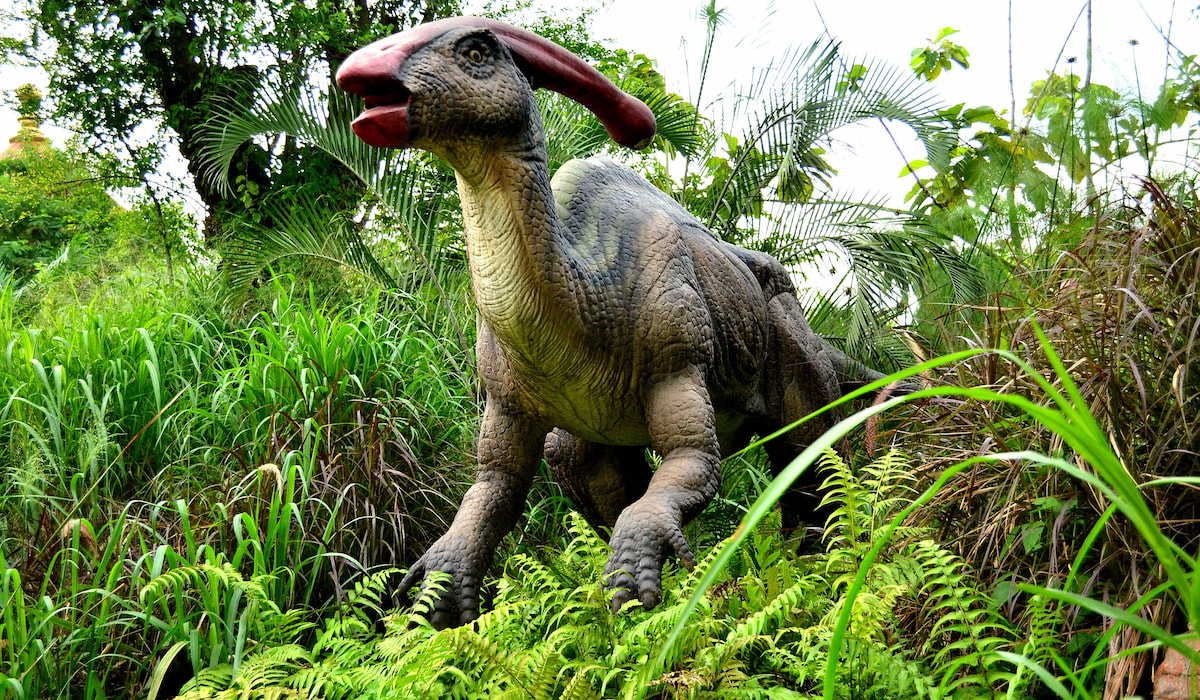
But did you know that not all dinosaurs are born with a reptilian appearance? In fact, there were a few species that had a duck-like bill. And they are known as hadrosaurids.
What Dinosaurs Had a Bill Like a Duck?
Based on our research, duck-billed dinosaurs or hadrosaurids can be divided into three major categories: the hollow-crested, non-crested, and basal types.
This classification was made based on the presence of crests found on top of their head.
Most duck-billed dinosaurs were unique and different from one another. They weren’t carnivores and only consumed plants.
To get a clearer picture, let’s take a look at each of them and learn about their morphology and place of origin.
Edmontosaurus
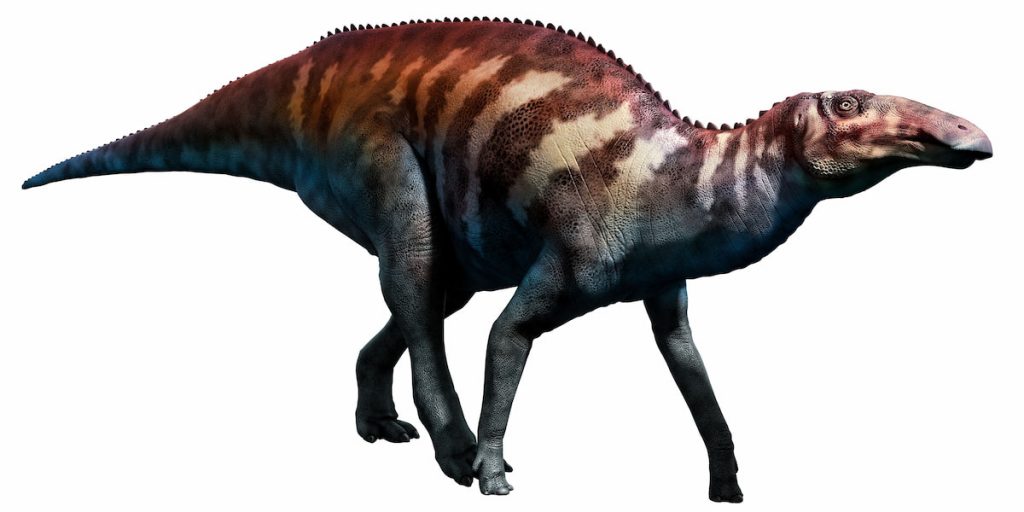
Edmontosaurus comprises two major species: Edmontosaurus annectens and Edmontosaurus regalis.
Their fossils were first discovered in the late 19th century in Canada and parts of the United States, such as South Dakota, Wyoming, and Montana.
These plant-eating dinosaurs measure between 40 and 49 feet long and are considered one of the biggest dinosaurs of their era.
Edmontosaurus belong in the non-crested group due to the lack of an obvious crest on their head. However, paleontologists have discovered that their crest was very small and appeared in the form of soft tissue.
These hadrosaurids walked on all fours but could use their hind legs to run.
They could run as fast as 28 miles per hour.
They rarely stayed isolated and preferred moving in a small herd or a large group.
Tsintaosaurus

Tsintaosaurus fossils were first discovered in 1958 and named by a Chinese paleontologist, C.C. Young. Their name was related to the place where their fossils were found, which is in Shandong Province, China.
Some people also called them the Qingdao lizard.
These hadrosaurids measure around 13 feet tall and 32 feet long. They weighed around 5,952 pounds (2,700 kilograms).
Tsintaosaurus can be characterized by their curved and unicorn-shaped crest on top of their head that extends down to their nasal bones. They had large tails and strong hind legs for swimming and paddling across the water.
Tsintaosaurus usually moved on all fours. However, they also had the ability to walk or run bipedally, especially when they wanted to feed on the branches of tall trees or escape predators.
These dinosaurs also fall under the hollow-crested group that lived mainly on a plant-based diet.
Shantungosaurus
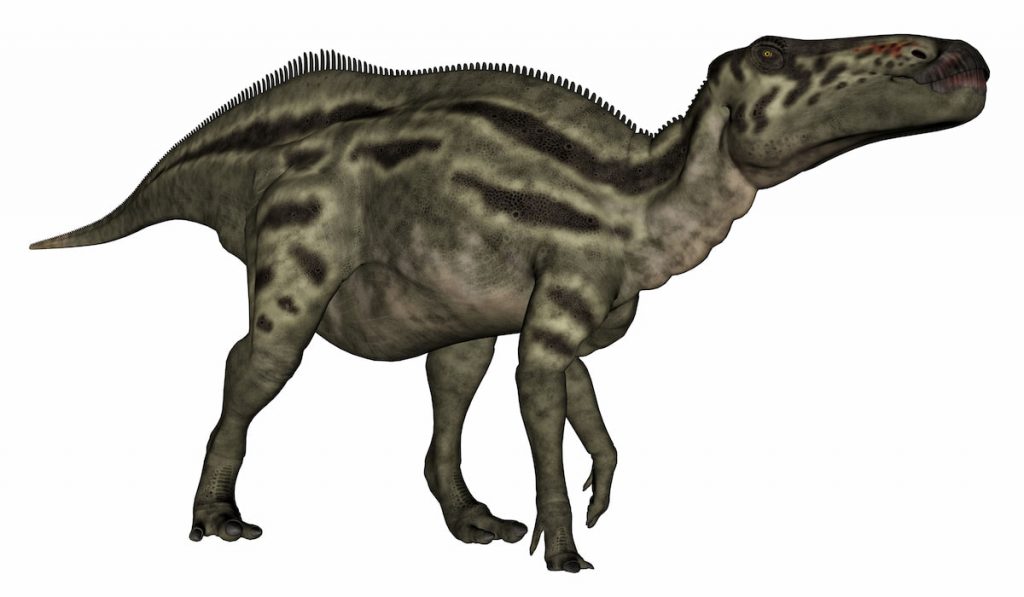
Shantungosaurus fossils were first discovered in the Shandong Peninsula, China, in 1973. They were categorized as hollow-crested hadrosaurids with no visible crest or comb-like structure on top of their skull.
Shantungosaurus was the biggest species out of all hadrosaurids that have ever existed.
They are also known as the Shantung lizard.
They measure around 23 feet high and 52 feet long, with a weight between 12 and 20 tons (24,000 and 40,000 pounds).
They also possessed duck-like bills, thick and large tails, and numerous teeth designed to grind and chew hard plant materials.
Similar to other hadrosaurids, they were quadrupedal creatures but possessed the ability to stand and move on both of their hind legs to reach tall branches or escape predators.
Lambeosaurus
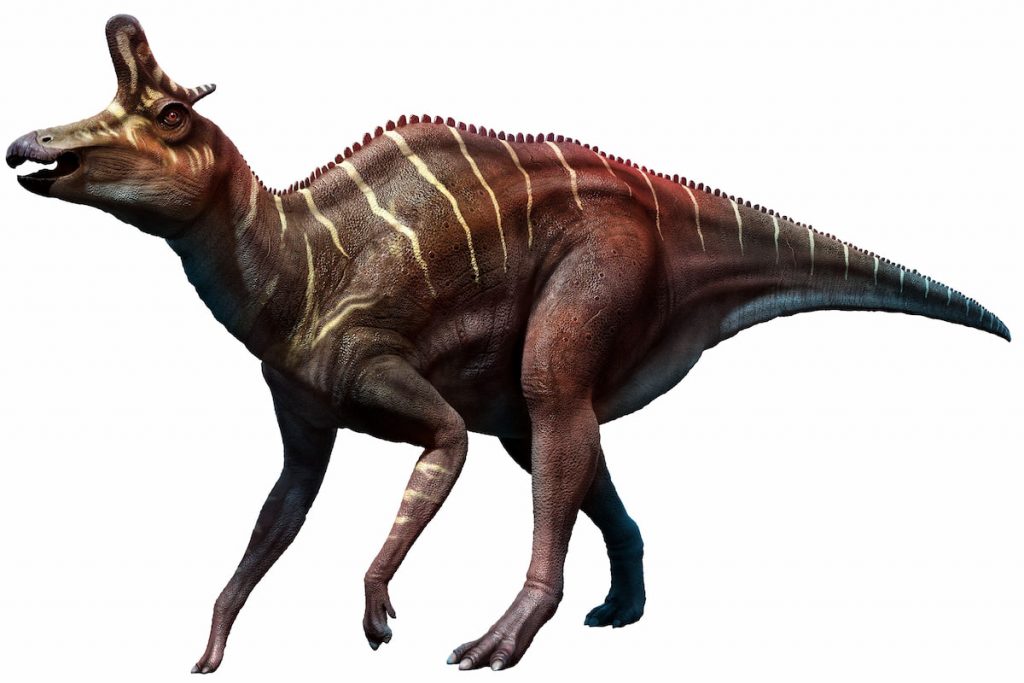
Lambeosaurus was a hollow-crested hadrosaurid. Their fossils were first discovered in the early 1900s in North America, particularly in Alberta, Montana, and Baja, California.
These dinosaurs were named after the paleontologist that discovered their fossils, Lawrence Morris Lambe.
Lambeosaurus stood around 7 feet tall at the hip, were 50 feet long, and weighed about 20 tons.
They had an axe-shaped crest on top of their skulls, duck-like bills, large nasal openings, thick, long tails, and three toes on each of their feet.
There is evidence that shows their crests were connected to their nasal cavities, thus helping in facilitating better airflow and breathing.
Being herbivorous dinosaurs, they possessed small teeth that were used to chew and grind on plants and branches.
Maiasaura
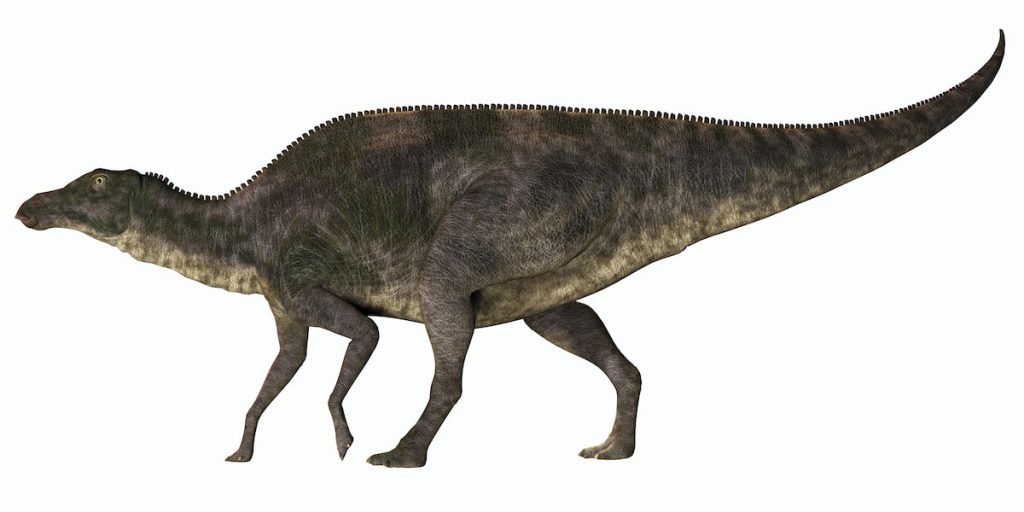
These duck-billed dinosaurs might resemble Tyrannosaurus rex from their face and head, but Maiasaura were actually herbivores and weren’t related to other carnivorous species.
Their fossils were first discovered in 1979 in the western United States, specifically in Montana.
Unlike most hadrosaurs, Maiasaura may have been bipeds, mostly using their hind legs to walk and run.
They measured around 30 feet long with a weight of at least 5 tons, which is quite small compared to other hadrosaurids.
Maiasaura were also categorized as non-crested hadrosaurids. They possessed a very small crest on top of their snout, a thick and large tail, and a broad duck-like bill.
Most hadrosaurs from this species were good mothers and nurturing toward their young.
A single Maiasaura could also lay between 30 to 40 eggs at once.
These dinosaurs usually lived and moved in a herd, considering that they were the target of other bigger dinosaurs such as Bambiraptor and Troodon.
Velafrons
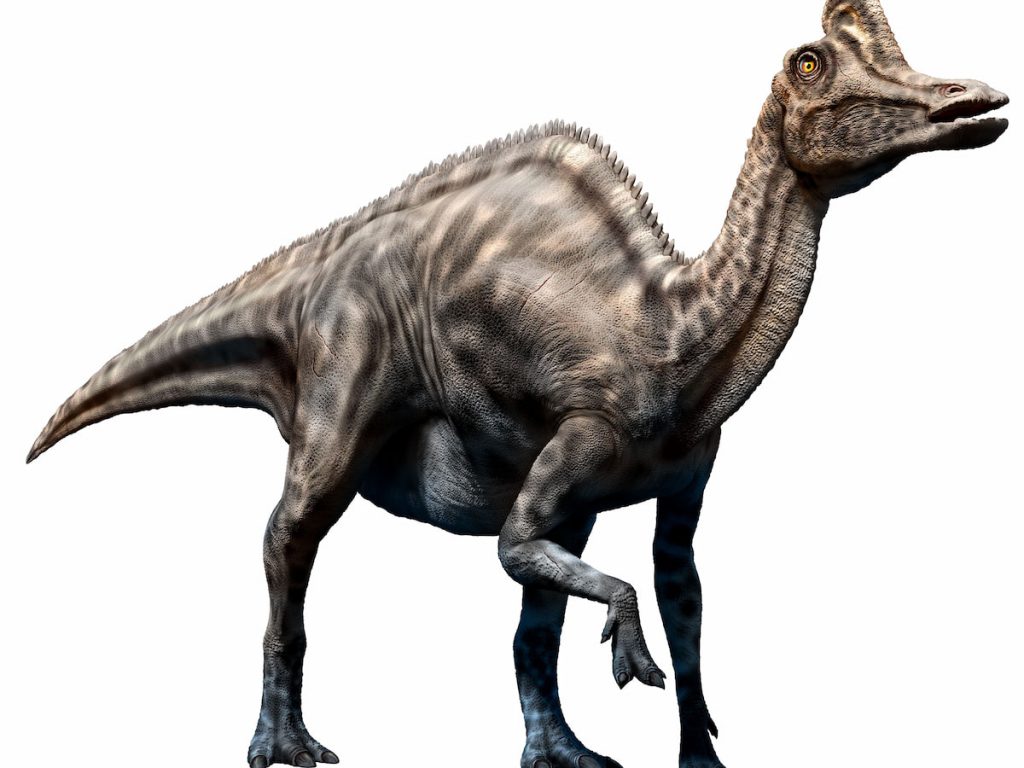
Velafrons were hollow-crested hadrosaurs. Their fossils were first discovered near Coahuila, Mexico. These dinosaurs measured between 25 and 33 feet long and mainly ate plants.
These hadrosaurids possessed a protruding crest on top of their front skull. They were also closely related to other species, such as Hypacrosaurus and Corythosaurus.
Like most hadrosaurs, they reproduced by laying eggs.
Saurolophus
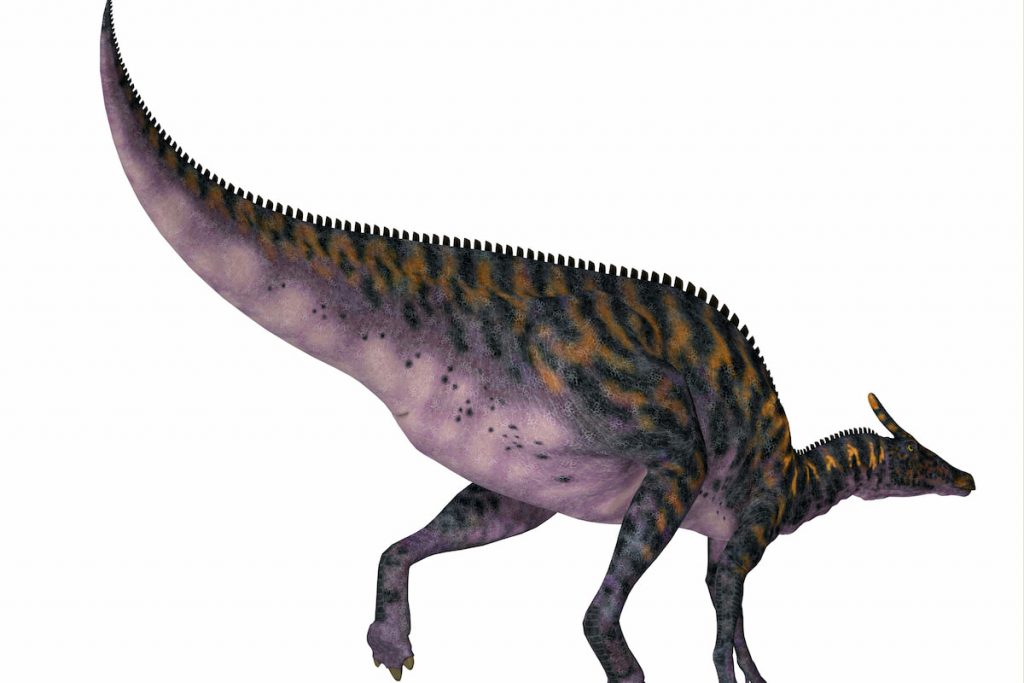
These large hadrosaurs lived in the Cretaceous period and measured between 30 and 40 feet long.
Saurolophus fossils were first discovered in 1912 in places such as Canada, China, and the United States. They were named by the paleontologist that found their fossils, Barnum Brown.
Saurolophus were categorized as hollow-crested hadrosaurs with a long and pointy hollow crest on top of their skull that extended up to 5 inches long.
They possessed toothless duck-like bills, thick and long tails, and three toes on each of their feet.
These dinosaurs were also capable of walking using their strong hind legs or on all fours.
Being herbivores, Saurolophus ate plant-based materials. They rarely moved alone and spent most of their time in a group.
Gryposaurus
Gryposaurus’s fossils were first discovered in 1914 in Canada and the United States. Well-known Canadian paleontologist Lawrence Lambe named them.
Gryposaurus are also known as hook-nosed lizards.
There are two types of Gryposaurus: crested and non-crested species.
These large dinosaurs lived in the late Cretaceous period and measured around 40 feet long.
They had a short duck-like snout or bill, a long and pointy tail, strong hind legs, and numerous teeth for chewing and grinding plant-based materials.
Gryposaurus were both bipedal and quadrupedal creatures. This flexibility helped them reach for tall branches or low-growing plants, as well as escape predators.
Like most hadrosaurids, Gryposaurus lived and moved in herds.
Claosaurus
Claosaurus are the smallest hadrosaurids, measuring around 6 feet tall and 11 feet long.
Their fossils were first discovered as early as 1890 in the United States, specifically in Montana, South Dakota, and Kansas.
These herbivorous dinosaurs had slender bodies, small front legs, strong hind legs, and pointy, long tails.
Some researchers have indicated that these hadrosaurids inhabited marine or aquatic environments or that they may have been killed in flooding.
Corythosaurus
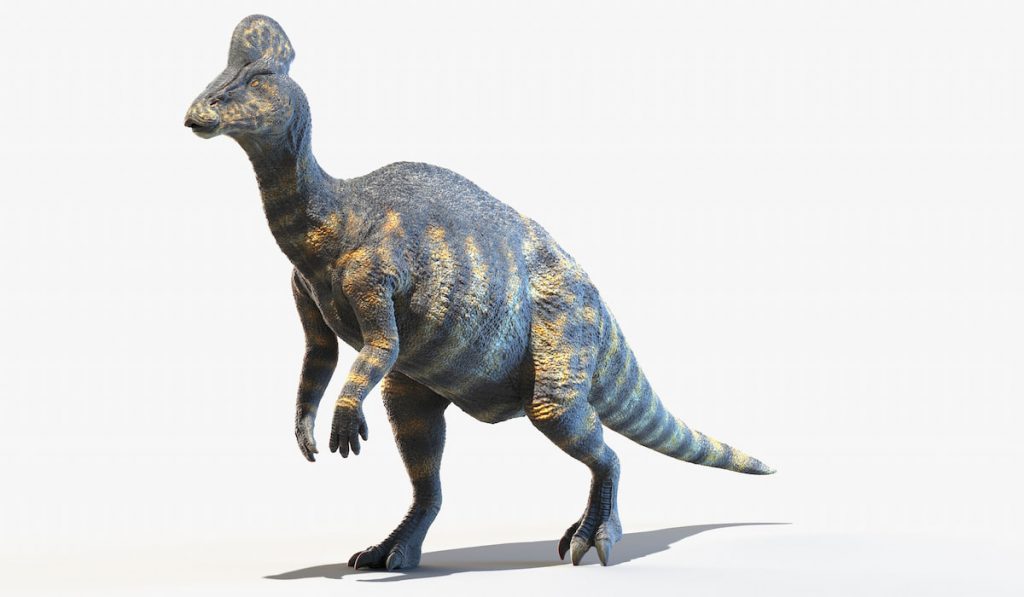
Corythosaurus lived in the late Cretaceous period, around 80 million years ago.
Their fossils were first discovered in Alberta, Canada, and Montana in the United States. American paleontologist Barnum Brown named them.
These large hadrosaurs measured between 25 and 30 feet long.
Corythosaurus had large, protruding crests on top of their skulls that extended up to 2 feet tall. They also had duck-like bills, small front legs, muscular hind legs, thick and long tails, and bumps covering their skin, known as tubercles.
Corythosaurus were herbivores that fed on plants, twigs, branches, and other plant materials.
Although they were quadrupedal hadrosaurs, they usually moved using both hind legs, contributing to their ability to swiftly escape and run from predators.
Brachylophosaurus
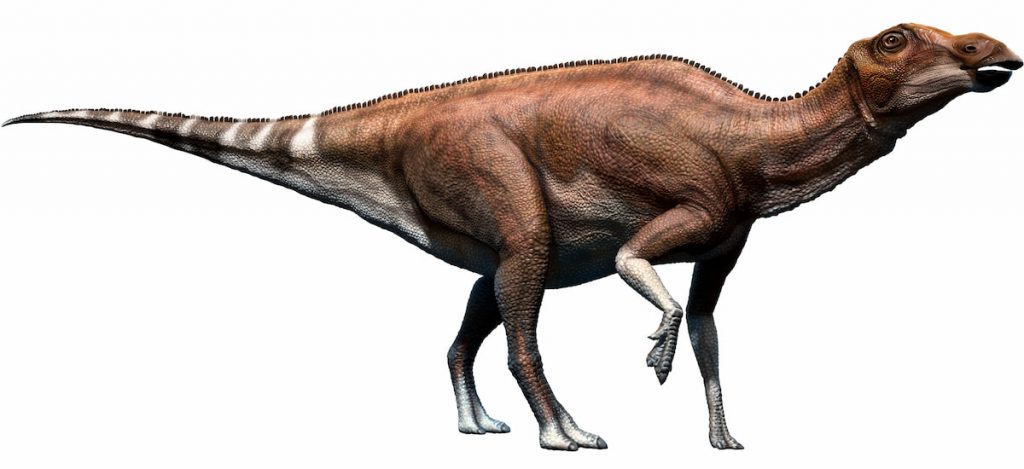
Brachylophosaurus fossils were first discovered in 1953 near Alberta, Canada, and in Montana in the United States. Canadian paleontologist Charles Sternberg named these dinosaurs.
Brachylophosaurus lived in the Cretaceous period and were hollow-crested hadrosaurs.
These large dinosaurs measured between 25 and 35 feet long and weighed between 5 and 7 tons.
Brachylophosaurus had large, broad duck-like bills, flat crests on top of their skulls, top beaks that curved slightly downward, and thick and long tails.
As herbivores, they used their muscular jaws to chew and grind soft or hard plant materials.
Parasaurolophus
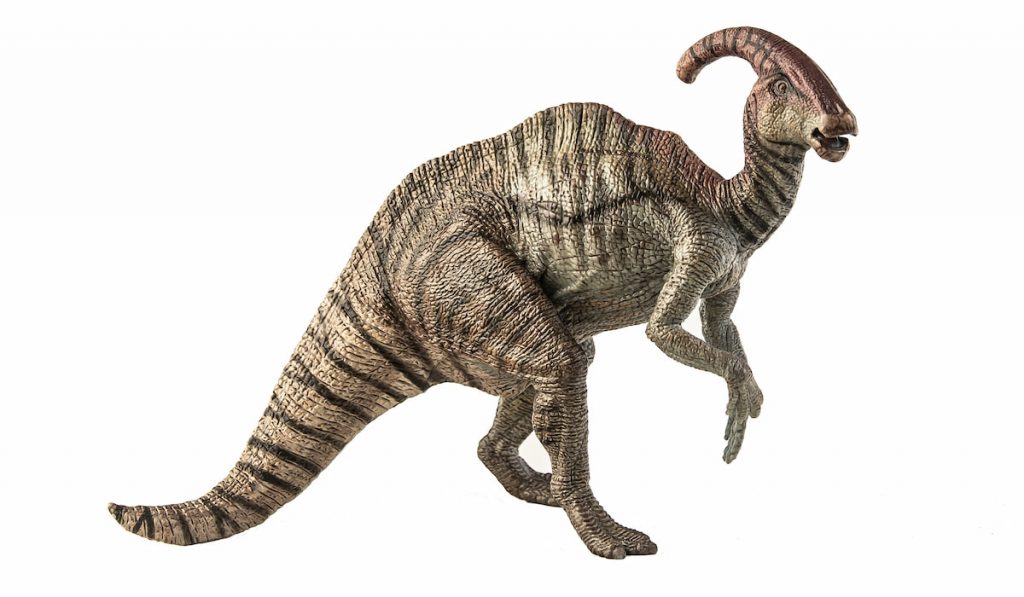
Some archeologists presume that Parasaurolophus lived in North America around 76 million years ago.
Their fossils were first discovered in the early 1900s near Alberta, Canada; New Mexico; Utah; and parts of China.
These hadrosaurs measured around 33 feet long and may have been both bipedal and quadrupedal creatures.
Parasaurolophus were hollow-crested hadrosaurs.
Parasaurolophus’ large crests curved backward and extended up to 5 feet!
Parasaurolophus could make a trumpet-like sound through holes inside of their crests. This would be their form of communication to attract potential mating partners or alert their herd about incoming danger.
Aquilarhinus
Aquilarhinus fossils were discovered in Texas. They were one of the hadrosaurids that lived during the late Cretaceous period, around 80 million years ago.
What made Aquilarhinus unique was the shape of its bill, which curved downward like an eagle’s beak.
These dinosaurs measured around 16 feet long and lived on a plant-based diet.
They also possessed three toes on each of their feet, thick and long tails, and small, protruding bony structures from the top of their heads to their tails.
Batyrosaurus
Batyrosaurus were basal hadrosaurids that lived in Asia around 86 million years ago during the late Cretaceous period.
Batyrosaurus fossils were discovered in Kazakhstan, specifically in the Kyzylorda region.
These medium-sized dinosaurs measured around 20 feet long and walked mostly on all fours. However, they possessed the flexibility to stand bipedally and reach for higher branches when feeding.
Like most duck-billed dinosaurs, they were herbivorous, egg-laying creatures that spent most of their time on the ground.
Amurosaurus
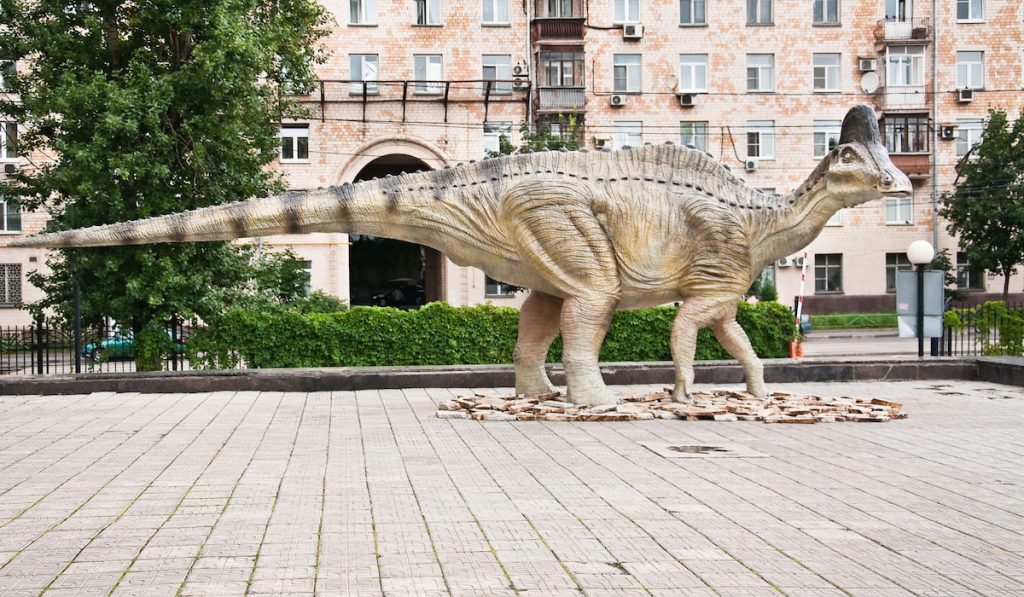
Amurosaurus may have lived in Asia around 66 million years ago.
Their fossils were first discovered in 1901 near the Amur river, which runs between eastern Russian and Northern China. Their discoverers named these dinosaurs after the river, so Amurosaurus literally means “Amur lizard.”
These dinosaurs were categorized as hollow-crested hadrosaurids. They measured between 20 and 26 feet long with a weight of at least 6,600 pounds.
Like most lambeosaurines, Amurosaurus possessed a distinctive, protruding hollow crest on top of their skulls.
They consumed plants and were capable of walking and running either by using their two hind legs or all on four.
Wulagasaurus
Wulagasaurus lived in the late Cretaceous period, around 69 million years ago, in what is now Heilongjiang Province, China. Similar to Amurosaurus, their remains were also discovered by the Amur River, the border of far eastern Russian and northern China.
Wulgasaurus measured around 30 feet long and weighed around 3 tons.
Wulagasaurus were categorized as basal hadrosaurids. Like other hadrosaur species, they were herbivorous creatures that fed on plant materials.
Theories have also suggested that these dinosaurs shared the same characteristics as other hadrosaurs, such as Brachylophosaurus and Maiasaura.
Bactrosaurus
Bactosaurus inhabited eastern China around 70 million years ago in the late Cretaceous period. Their fossils were discovered in China and Mongolia.
American paleontologist Charles W. Gilmore named these dinosaurs in 1933.
Bactrosaurus were 20 feet long, 4.5 feet tall at the hips, and weighed around 1.7 tons.
Bactrosaurus possessed hardly visible crests on the top of their skulls, duck-like bills, long tails, and club-shaped bony structures (neural spines) along their backbone.
Bactrosaurus usually walked using their hind legs but could also use their four feet for feeding purposes. Like most hadrosaurs, they were herbivores.
Eolambia
In 1992, Carol and Ramal Jones found Eolambia fossils in Utah. Eolambia is one of many hadrosaurids found in the United States.
Research shows that these hadrosaurids may have inhabited the same environment as armored and ornithopod dinosaurs.
Like most duck-billed dinosaurs, Eolambia were herbivorous creatures that consumed twigs, branches, and other plant material.
Eolambia measured 20-30 feet long and weighed around 1 ton.
These dinosaurs reproduced by laying eggs and were categorized as both bipedal and quadrupedal creatures.
Altirhinus

Out of all dinosaurs mentioned in this list, Altirhinus is probably the outlier.
Altirhinus had the closest relation to ornithopod dinosaurs. They also lived much earlier than other hadrosaurs, which was in the early Cretaceous period, around 100 million years ago.
Altirhinus’ fossils were discovered in Mongolia.
They measured around 26 feet long with a weight of at least 4 tons. They possessed broad and high duck-like snouts, wide mouths, and a tall arch on top of their snouts that helped them breathe and make sounds.
Altirhinus were also herbivorous dinosaurs that had the flexibility to walk using their two hind legs or on all fours.
Barsboldia
Barsboldia were hollow-crested hadrosaurs that lived during the early Maastrichtian period.
Their fossils were discovered in 1981 near the Nemegt Formation in Mongolia. These large dinosaurs were also named after a Mongolian paleontologist, Rinchen Barsbold.
Barlsbodia measured between 39 and 46 feet long and weighed around 5.5 tons.
They were easily recognized by the hollow crest on top of their skulls and numerous neural spines projecting along the back of their large bodies.
These dinosaurs were also known to be both bipedal and quadrupedal hadrosaurs. Like most duck-billed dinosaurs, Barlsbodia only ate plants.
Jaxartosaurus
Jaxartosaurus, literally “Jaxartes lizard,” was one of the many hadrosaur species that lived in the late Cretaceous period, around 83 million years ago.
Their fossils were discovered near the Jaxartes River in Kazakhstan, from which they received their name.
These large dinosaurs measured around 16 feet tall and 30 feet long, with a weight of around 4 tons. They possessed large, helmet-like hollow crests, flat cheek teeth, and duck-like bills.
Like most hadrosaurs, they were herbivores that only consumed twigs, branches, and plant materials.
Jaxartosaurus were categorized as hollow-crested hadrosaurs. They were both bipedal and quadrupedal dinosaurs.
Huehuecanauhtlus
These dinosaurs have a unique and complex name to pronounce! Their fossils were discovered in Michoacán, Mexico.
Huehuecanauhtlus were one of the hadrosaurs that existed during the late Cretaceous period, specifically in the Santonian Age.
Huehuecanauhtlus are estimated to be at least 20 feet long.
Because we only have two specimens of this dinosaur, researchers aren’t sure of many details.
However, researchers think these hadrosaurs had tall, distinctive neural spines protruding from their backbone. They were also herbivores that consumed plants.
Angulomastacator
Angulomastacator lived in the Campanian Age of the late Cretaceous period, around 76 million years ago. Their remains were discovered in the Aguja Formation in Texas.
These hadrosaurs are one of the species from the hollow-crested group.
Angulomastacator possessed a hollow crest on top of their skulls that was connected to the nasal cavity. They also had distinctive downward-curved jaws.
They could walk using both of their hind legs or on all fours.
Researchers don’t have enough evidence to estimate the size of these dinosaurs.
Like most hadrosaurs, Angulomastacator were herbivores. They moved in a large herd, and the females were nurturing toward their young.
Charonosaurus
Charonosaurus fossils were discovered in the Amur River in 1975. However, the exact location for this discovery may have been in China, near the Yuliangze Formation.
Similar to most hadrosaurs, Charonosaurus lived during the late Cretaceous period.
These large dinosaurs measured around 33 feet long and weighed around 5.5 tons.
They had long, backward curved crests on top of their skulls, long, thick tails, and numerous neural spines projecting from their backbone.
Like most hadrosaurs, Charonosaurus were herbivores. These dinosaurs also belonged to the hollow-crested group.
Hypacrosaurus
Hypacrosaurus lived in the late Cretaceous period and were named by the American paleontologist Barnum Brown. Their fossils were discovered in two locations, Montana and Alberta, Canada.
Hypacrosaurus means “near the highest lizard,” which is comparable to the famous Tyrannosaurus rex.
These dinosaurs were categorized as hollow-crested hadrosaurs.
Hypacrosaurus had large, hollow-crested crests that were shaped like helmets.
Similar to Parasaurolophus’ crests, Hypacrosaurus’ crests could produce noise to attract potential mating partners.
Hypacrosaurus measured between 10 and 13 feet tall, 30 feet long, and weighed between 1.3 and 4 tons.
Like most hadrosaurs, they were herbivores. They had hundreds of teeth for chewing and grinding hard plant materials.
Telmatosaurus
Telmatosaurus once inhabited a Cretaceous region called Hateg Island, which is now part of Romania. Their remains were discovered in Transylvania and in the Sanpetru Formation.
Telmatosaurus were basal hadrosaurs.
Telmatosaurus measured around 16 feet long and weighed around 1,300 pounds, which made them one of the smallest hadrosaurs.
Paleontologists discovered benign tumors under their jaws called ameloblastomas.
Like most duck-bill dinosaurs, Telmatosaurus only ate soft plants and seeds. Because of their small bodies, they didn’t consume as much as other large hadrosaurs.
Olorotitan
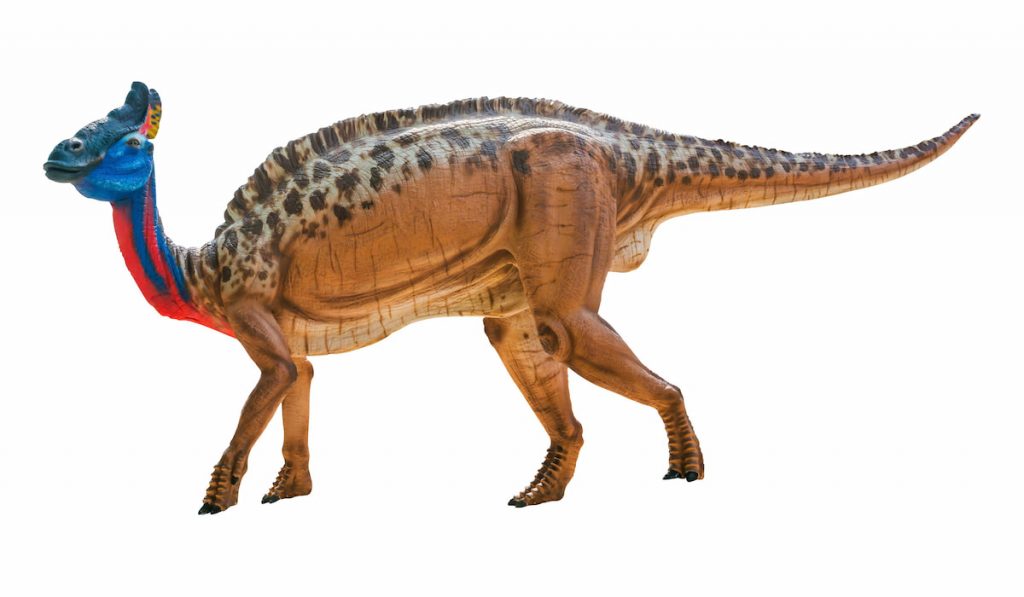
Olorititan was one of the largest hadrosaurs that lived in the Maastrichtian age of the Cretaceous period. Their name literally means “large swans,” as they have longer necks than other hadrosaurs.
These dinosaurs measured around 11 feet tall and 26 feet long and weighed between 3 and 4 tons. They belonged to the hollow-crested group and had large, hatchet-shaped hollow crests on top of their skulls.
Olorititans also had long, pointy tails and numerous neural spines projecting from their backbone.
These herbivorous hadrosaurs were categorized as both bipedal and quadrupedal creatures. Their remains were discovered near the Amur River in far eastern Russia in 1999.
Sahaliyania
Sahaliyania remains were found in the same region as Wulagasaurus, near the Yuliangze Formation in Heilongjiang, China. They lived in the Maastrichtian age, around 66 million years ago.
These hadrosaurs possessed duck-like bills and distinctive crests on top of their skulls.
There is not much information about this species due to the lack of specimens. However, researchers have indicated that Sahaliyania were herbivorous creatures like most hadrosaurs.
Tethyshadros
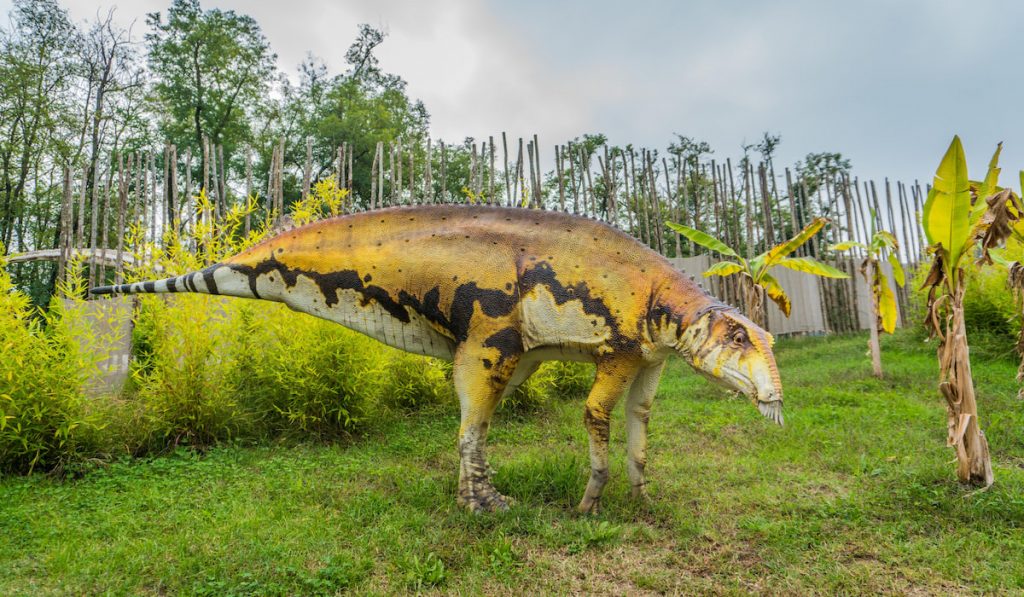
Tethyshadros originated from Trieste Province, Italy. Their remains were found near Villagio del Pescatore in the Liburnia Formation.
Italian paleontologist Fabio Della Vachia described and named these dinosaurs in 2009. He named them after the Tethys Ocean that existed during the Mesozoic Era.
These dinosaurs were categorized as dwarf hadrosaurs.
They measured between 12 and 15 feet long and weighed between 745 and 1,287 pounds.
Tethyshadros can be characterized by their small bodies, duck-like bills, long limbs with three toes, and thick, pointy tails. Unlike most hadrosaurs, they didn’t have any crests on top of their skulls.
Final Thoughts
Although we can’t witness any of these duck-billed dinosaurs or any type of dinosaurs in real life, paleontologists managed to preserve some of their fossils for research and preservation.
What’s more interesting is that these duck-billed dinosaurs have shattered the stereotypical image that all dinosaurs were once vicious reptiles.
Resources
- https://www.amnh.org/dinosaurs/dinosaur-facts
- https://adventuredinosaurs.com/2020/08/29/types-of-duck-billed-dinosaurs
- http://www.prehistoric-wildlife.com/species/e/edmontosaurus.html
- https://www.fossilguy.com/gallery/vert/dinosaur/edmontosaurus/index.htm
- https://abcdino.com/en/dinosaur/tsintaosaurus/
- http://www.prehistoric-wildlife.com/species/t/tsintaosaurus.html
- https://kids.britannica.com/students/article/Shantungosaurus/390682
- http://www.prehistoric-wildlife.com/species/s/shantungosaurus.html
- https://www.sdnhm.org/exhibitions/fossil-mysteries/fossil-field-guide-a-z/lambeosaurus/
- http://www.prehistoric-wildlife.com/species/l/lambeosaurus.html
- https://www.thoughtco.com/things-to-know-maiasaura-1093792
- http://www.prehistoric-wildlife.com/species/m/maiasaura.html
- https://dinosaurpictures.org/Velafrons-pictures
- http://www.prehistoric-wildlife.com/species/v/velafrons.html
- https://www.enchantedlearning.com/subjects/dinosaurs/dinos/Saurolophus.shtml
- http://www.prehistoric-wildlife.com/species/s/saurolophus.html
- https://nhmu.utah.edu/gryposaurus-monumentensis
- http://www.prehistoric-wildlife.com/species/g/gryposaurus.html
- https://gwangipedia.fandom.com/wiki/Claosaurus
- http://www.prehistoric-wildlife.com/species/c/claosaurus.html
- https://kids.britannica.com/students/article/Corythosaurus/310838
- https://en.wikipedia.org/wiki/Corythosaurus
- https://animals.howstuffworks.com/dinosaurs/brachylophosaurus.htm
- https://mtdinotrail.org/brachylophosaurus/
- https://en.wikipedia.org/wiki/Parasaurolophus
- https://kids.nationalgeographic.com/animals/prehistoric/facts/parasaurolophus
- https://en.wikipedia.org/wiki/Aquilarhinus
- https://nixillustration.com/science-illustration/2021/aquilarhinus/
- https://dinosaurpictures.org/Batyrosaurus-pictures
- http://www.prehistoric-wildlife.com/species/b/batyrosaurus.html
- https://en.wik ipedia.org/wiki/Amurosaurus
- https://artsandculture.google.com/asset/amurosaurus-the-crested-duck-billed-dinosaur/igFUKb1Pv9KGuA?hl=en
- http://www.prehistoric-wildlife.com/species/a/amurosaurus.html
- https://en.wikipedia.org/wiki/Wulagasaurus
- http://www.prehistoric-wildlife.com/species/w/wulagasaurus.html
- https://abcdino.com/en/dinosaur/bactrosaurus/
- https://www.enchantedlearning.com/subjects/dinosaurs/facts/Bactrosaurus/
- https://abcdino.com/en/dinosaur/eolambia/
- http://www.prehistoric-wildlife.com/species/e/eolambia.html
- http://www.prehistoric-wildlife.com/species/a/altirhinus.html
- https://www.dinosaurjungle.com/dinosaur_species_altirhinus.php
- https://en.wikipedia.org/wiki/Barsboldia
- http://www.prehistoric-wildlife.com/species/b/barsboldia.html
- http://www.prehistoric-wildlife.com/species/c/charonosaurus.html
- https://en.wikipedia.org/wiki/Charonosaurus
- https://www.enchantedlearning.com/subjects/dinosaurs/facts/Jaxartosaurus/
- https://abcdino.com/en/dinosaur/jaxartosaurus/
- https://a-dinosaur-a-day.com/post/184216133165/angulomastacator-daviesi
- http://www.prehistoric-wildlife.com/species/a/angulomastacator.html
- https://en.wikipedia.org/wiki/Huehuecanauhtlus
- http://www.prehistoric-wildlife.com/species/h/huehuecanauhtlus.html
- http://www.prehistoric-wildlife.com/species/h/hypacrosaurus.html
- https://abcdino.com/en/dinosaur/hypacrosaurus/
- http://www.prehistoric-wildlife.com/species/t/telmatosaurus.html
- https://en.wikipedia.org/wiki/Telmatosaurus
- http://www.prehistoric-wildlife.com/species/o/olorotitan.html
- https://en.wikipedia.org/wiki/Olorotitan
- http://www.prehistoric-wildlife.com/species/s/sahaliyania.html
- https://en.wikipedia.org/wiki/Sahaliyania
- https://en.wikipedia.org/wiki/Tethyshadros
- http://www.prehistoric-wildlife.com/species/t/tethyshadros.html